


Pillow
The pillow is the complement to true relaxation.
It must properly support, without compressing, and relax the cervical vertebrae, muscles and nerve pathways concerned.
The wide range of pillows we make naturally adapts to different needs.
Mattress
Thanks to the use of excellent materials and careful workmanship, our mattresses perfectly support the body in relation to its weight and anatomical shape.
They offer a synergic action with the slatted support and make load and thrust stresses harmonious.
Slatted base
In a good bed system, the bed base is fundamental for the correct functioning of the mattress and the support of the entire structure.
Our bed bases work in complete synergy with the mattresses, developing specific comfort zones for each part of the body.
The use of multilayer beech makes our anatomical supports unique in terms of robustness and reliability.

The Ideal Bed System
The importance of an integrated Bed System.
Comfortable and cosy to aid sleep but hygienic and ergonomic to care for the spine.
This is how the ideal bed should be.
Decades of research have shown that the balance between its component parts is essential, because even the best mattress is inefficient if it does not harmonise with the slatted frame that supports it. In fact, mattress, slatted frame and pillow must work in synergy, support the back, follow its natural shape and react elastically to any pressure.
This is the best and healthiest condition for rest and is what the Dorsal Bed System develops.
How to choose the ideal mattress
The Physiotherapist's Word

In the Bed System, the mattress is the element that, together with the pillow and the anatomical support, allows the correct balance in the alignment of the spinal column, in the different segments of its structure: cervical, thoracic, lumbar and pelvis.
What aspects should be considered when choosing the ideal mattress?
The choice of a new mattress must take into account the elements that make up the entire Bed System. In fact, even the best mattress placed on an inadequate support and combined with an unsuitable pillow, compromises the postural balance of the entire structure. The spinal column, in an ideal mattress, is aligned, balanced and therefore relaxed in respect of the body's natural curves.
The purchase of a new mattress will take into account important factors such as comfort, breathability, support, and above all the morphological characteristics of the user, personal needs, and also the positions predominantly assumed during falling asleep or resting.
Mattress customisation
An important aspect to consider when customising a mattress is the physical structure of the individual in terms of weight and height: for example, in mattress size, it is essential that the length is on average 15 to 20 cm longer than the height of the user.
Other decisive factors to consider when choosing a new mattress are any major pathologies and/or special requirements for mattress comfort. Thermoregulation is also a reason for customising a mattress, for people who are particularly sensitive to heat or cold. In this case, the choice of highly breathable materials will be a great advantage in creating a perfect microclimate throughout the year and thus limiting nocturnal awakenings.
If the mattress is too soft or too firm
A mattress that is too soft, as well as one that is too firm, can lead to postural misalignments and muscular stress that can cause tension and musculoskeletal disorders during sleep and are often felt when waking up in the morning. Cervicalgia and cervicobrachialgia, as well as lumbago and lumbosciatica can be the consequence.
Tips for a perfect mattress
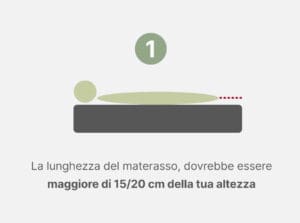
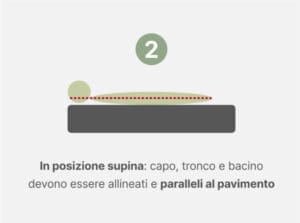
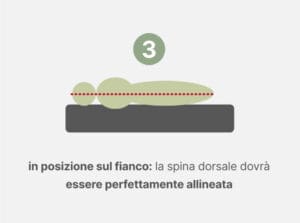
How to choose the perfect pillow
The Physiotherapist's Word
The choice of an adequate head and neck support is a fundamental element in guaranteeing a correct postural position for your entire body. A healthy and regenerating rest cannot do without a pillow that best supports the cervical area and can prevent compression in the cervical-dorsal tract, a key area for lymphatic drainage of the entire body. It is of paramount importance that the pillow is comfortable and does not increase the basal temperature to promote a deeper and thus more effective and restorative sleep.
When choosing a pillow, thickness, hardness and shape should be taken into account, without ever forgetting comfort and the prevailing position you assume during sleep.
The positions you adopt during the night change frequently.
However, choosing as the ‘trial’ position of the pillow the one in which you fall asleep or the one that you predominantly assume in your sleep, is a fundamental element to consider when buying.
The shape
The choice of shape, whether classic or shaped, may depend on the subjective feeling of comfort and the need to have, as in the case of a shaped pillow (i.e. with different heights between the apex and base) more support and stability for the neck.
Height
As far as height is concerned, different thicknesses will certainly have to be considered depending on whether the ‘prevailing or sleeping’ position is belly up or lying on one's side, and on the width of the head-neck segment.
It should not be forgotten that there is a close interdependent relationship between pillow, mattress and anatomical support: if the mattress is more yielding or softer, the shoulder support will require a lower pillow height; if, on the contrary, the mattress is more supportive, a pillow of a height suited to the conformation of the shoulders should be considered.
If you sleep on your stomach, the general suggestion is not to use pillows or to use very low ones so as not to stress the cervical area in hyperextension (always and in any case supporting the concept of comfort).
The correct positions
The ideal pillow allows correct support of the cervical section while maintaining the physiological position of the invertebral discs and ligaments, without any tension.
The wrong positions
Pillows that are too high or, on the contrary, too low, compared to the ideal alignment, produce abnormal strains and tensions that can result in muscle stiffness and annoying contractures in the neck area but also, reflexively, in nearby body districts.
How to choose the perfect anatomical support
The Physiotherapist's Word
The task of the bed base is to act as a shock absorber between the floor and the mattress and thus complete the function of distributing body loads and levers, together with the mattress and pillow. The bed base must guarantee strength and solidity, but also the right bearing capacity and elasticity to favour the correct distribution of weight, especially in the pelvis and shoulder areas.
What aspects must be considered when choosing the most suitable anatomical support for the bed system?
The choice of the most functional anatomical support for the bed system must absolutely take into account the characteristics of your mattress or the mattress you intend to purchase, because the elements of the bed system must work in synergy with each other: even the best mattress placed on a support that is inadequate for the person's characteristics will certainly lower the level of well-being and total postural balance.
There are various types of bed bases with different bearing capacities that vary according to your build and weight: if we wanted to obtain a ‘rigid’ bed system, for example. , the bed base will have to be supported, thus influencing the bearing capacity of the mattress. When choosing a soft bed system, you can also consider using systems with suspension or ergonomic springs.
In the ergonomic versions, the anatomic supports are designed with zones of differentiated bearing capacity, which entails the ability to manage loads according to the different body zones and this is once again an advantageous element.
It should be emphasised that data obtained from specific tests carried out at certified laboratories have highlighted the importance of slatted support compared to the Bed System as a whole, in a percentage varying from 20% to 40%, demonstrating that anatomical support plays a fundamental role in achieving an optimal result in terms of support, comfort and anatomical adaptability.
What is the function of the rigidity sliders?

The purpose of sliders is to make the slat more or less elastic-soft in the central area of the pelvis depending on whether they are moved closer together or further apart. If, for example, we consider the need for more support in the lumbar region, in order to improve overall posture, we can act through the sliders to provide more resistance to that body district.